What exterior painting actually covers
Exterior painting is everything on the outside of your building that carries a coat. Render walls, brickwork, weatherboards, fibro sheets, eaves, fascia, gutters, downpipes, barge boards, garage doors, window frames, timber trims, front doors, fences, retaining walls, verandah posts. Some jobs are the whole lot in one go. Others are just the sun-damaged side, or the fascia and gutters, or the front elevation to lift the kerb appeal before a sale.
PKB Painting is based in East Adelaide and we repaint homes and small commercial premises right across the metro. Sandstone cottages in painter Kensington, 1920s bungalows around painter Norwood, post-war brick veneers in painter Newton, weatherboard homes up in the foothills, newer render-and-brick builds across painter Prospect and out towards the western suburbs.
Every place gets a different plan. The prep is different, the primer is different, and often the top coat is different too. A limestone-front cottage needs a different system to a foam-clad modern facade. What holds up on a shaded south wall won't last on a west wall taking direct summer sun.
If your place looks chalky or patchy, the render is showing hairline cracks, the eaves are peeling, or the weatherboards are grey and cupping, exterior painting is the fix. Done properly it seals the building against water and UV. A cheap job comes back to bite you inside a couple of summers.
Why exterior paint fails in Adelaide
The problems homeowners notice usually fall into a handful of patterns:
- The colour has faded uneven, worse on the north and west sides.
- Paint is flaking or peeling off render, fascia or eaves.
- Timber weatherboards are cupping or splitting, with bare grey patches showing.
- The render has hairline cracks, sometimes with dark staining below them.
- Gutters and downpipes have rust bubbling through the paint.
- Chalky white powder comes off the wall when you rub a hand across it.
- The front door and window frames look tired next to the rest of the property.
- Paint has lifted around window and door frames where the caulking has failed.
Adelaide's climate is behind most of it. Summer sun sits on the north and west walls for hours a day. UV cooks the binders in exterior paint, so the pigment loses its grip and dusts off. That's the chalking. Cheap coatings chalk inside two or three summers. Quality exterior acrylics like Dulux Weathershield and Wattyl Solagard hold their colour and their film for eight to fifteen years, depending on the exposure.
Winter brings sharp cold-to-warm swings and driving rain from the south-west. Older render moves as the walls warm and cool through the day. Hairline cracks open up. Water gets in behind the coating, and the next hot day it turns to vapour and pushes the paint off in sheets. That's why filling and priming render cracks properly before a repaint matters so much.
Coastal jobs down at painter Glenelg and out along the beach suburbs have salt in the air on top of everything else. Salt eats paint film and any exposed steel, so fascia, gutters, downpipes and metal frames need a proper marine-grade or heavy-duty enamel system, not a general purpose house paint.
Adelaide's soil moves too. Reactive clay soils across the plains, and in a lot of the eastern suburbs including painter Unley, cause slab and footing movement between wet and dry seasons. That movement telegraphs through the walls as fine cracks, and every crack is a way in for water. A proper exterior repaint deals with all of that: crack filling, caulking around joins, and coating up to the sealant so the whole envelope stays watertight.
The other big factor is the housing stock. East Adelaide is full of solid-render-over-stone cottages, some going back a hundred years. That old render is often lime-rich and breathes differently to modern acrylic render. A hard, non-breathable modern paint traps moisture from below and lifts off in patches. Same story with old lead-based paint under newer coats. If the prep isn't right, the whole coating system delaminates.
Newer builds and townhouses across the metro have their own quirks. Fibre cement sheeting expands and contracts. Foam cladding needs a coating that stays flexible. Aluminium fascia and Colorbond need an etch primer or the top coat peels off in strips. A painter who treats every surface the same will get every job wrong.
How PKB Painting does the job
Here's what actually happens from your first call to the last drop sheet folded up. Every job runs differently, but the flow is the same. Assess it, prep it, coat it, walk it with you at the end. If any of those steps get skipped, you get a paint job that looks OK for a summer then starts to fail. So we do them all.
1. On-site quote. We come out, walk the whole exterior with you, get up a ladder where we need to, and work out what's really going on. Some jobs are a straight clean-and-repaint. Others need render repairs, timber replacement, rust treatment or lead-paint containment before a brush goes near them. We tell you what we find, what it means for the job, and what your options are. Then you get a written quote with the surfaces listed, the coats specified and the timeframe estimated.
2. Booking around the weather. Once you're happy, we lock in the dates. Exterior painting needs stable weather. Paint won't cure on a wet surface, won't level in a 40-degree northerly, and won't bond if it's below the manufacturer's minimum temperature. We watch the forecast in the week before your job and shift the start day if we need to. You'll always know a day ahead.
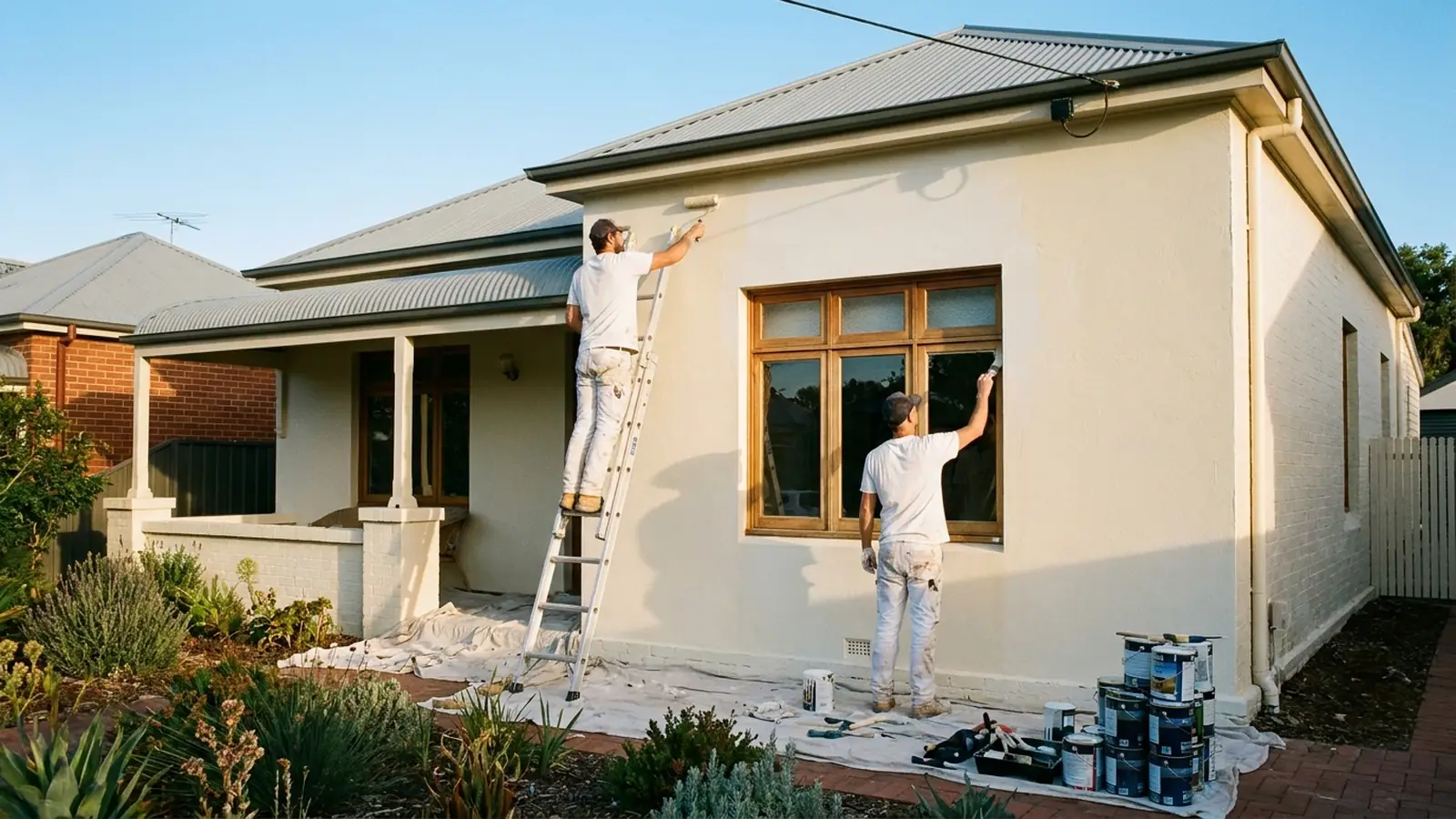
3. Set up and protection. Day one, we drop-sheet the garden beds, tape the windows and put plastic over anything that shouldn't get overspray. We move outdoor furniture, cover the pool if there's spray work nearby, and protect paving. Signs on the fence let neighbours and delivery drivers know what's going on. The site gets tidied every afternoon.
4. Pressure clean. The whole exterior gets washed down. Dirt, dust, cobwebs, mildew, chalky old paint. All of it has to come off. Fresh paint won't bond to a dirty surface, and any organic growth left underneath will feed through the new coat. On a stubborn wall we use a sugar-soap or biocide wash before the pressure rinse.
5. Scraping, sanding and repairs. Any flaking or peeling paint gets scraped back to a sound edge and feathered. Bare timber gets sanded to a clean profile. Bare render gets a bonding coat. Rusted metal gets wire-brushed and treated. Cracks in render get raked out and filled with a flexible exterior filler that moves with the wall. Rotten timber gets cut out and replaced. Gaps around windows, doors, weatherboard joints and penetrations get caulked with a paintable exterior sealant so water can't get in behind the finish.
6. Priming. Chalky surfaces get a chalk-binding primer. Bare timber gets an oil or acrylic primer suited to the species. Tannin-heavy hardwoods get a stain-blocker. Bare metal gets an etch or zinc primer. Old oil-based trims that are being top-coated with acrylic get an adhesion primer. This is the step where the eight-year job pulls away from the two-year job.
7. Top coats. Two full coats of a quality exterior acrylic on walls and eaves. A separate enamel or acrylic gloss on doors, trims and metal. Cut in by hand around windows, edges and detail. Big wall areas get sprayed for an even film thickness, then back-rolled to work the paint into the texture. Metal roofs, fascia and downpipes get a proper metal coating so the film flexes with the substrate rather than cracking off it.
8. Walk-through and clean-up. Last day, we walk the whole job with you. Runs, light patches, missed spots, overspray, tape marks. Anything you're not happy with, we fix before we pack the trailer. Rubbish goes with us. Empty paint tins go to licensed disposal. When we drive off, the place looks how you wanted it.
Gear, brands and standards we work to
The tools matter, but not as much as knowing when to use each one.
We run commercial-grade airless sprayers for big render walls and long fascia runs. Sprayed and back-rolled is the fastest way to get an even film across a large surface, and back-rolling works the paint into the texture so it locks in properly. For cut-in and detail work we use quality brushes and lambswool or microfibre rollers matched to the surface. Pressure cleaners for prep. Extension poles for eaves and second-storey work. Harnesses, edge protection or scaffold where the height and pitch call for it.
For older heritage-look buildings we spec specialty finishes: masonry paints designed for lime-render substrates, low-sheen textures that read as historically appropriate, and mineral-based coatings on facades where a modern acrylic would trap moisture. On modern homes we use the current premium acrylics because they hold up better under UV than the old formulas ever did.
For paint we work mostly with Dulux, Wattyl and Taubmans. Their premium exterior lines (Weathershield, Solagard and All Weather) are built for Australian conditions and give the longest service life on sun-hammered walls. On metal roofs, fascia and steel gutters we use the correct enamel or acrylic system so the coating flexes with the metal as it expands and contracts. On rust-prone areas we use a proper metal primer, not a general bonding coat.
Ladder and access work follows AS/NZS 1892 for portable ladders. Two-storey exterior work gets proper edge protection or a scaffold where the height and roof pitch require it, in line with SafeWork SA guidance on working at heights. Every coat goes on inside the paint manufacturer's specified surface temperature, humidity and recoat windows. Those numbers on the tin are what the product is warranted against, and ignoring them is how a job fails inside 12 months.
For older homes that might have lead-based paint under the current coats, we handle prep in line with AS 4361.2, the standard covering management of lead paint in a domestic setting. That means wet-sanding rather than dry-sanding on suspect surfaces, dust containment, bagging waste properly, and keeping the site clean for your family and our painters. It adds a bit of time and a bit of cost, but it's the right way to do it.
Urgent exterior work
Not every exterior job can wait three weeks. Sometimes a storm has ripped a piece of fascia off and left raw steel exposed. Sometimes a tenant is moving in on Monday and the front elevation needs to look presentable. Sometimes a real estate agent is booking photography for Saturday and the trims are peeling. Sometimes water has been getting behind a wall and you need it sealed before the next front rolls in from the south-west.
Ring us and tell us what's going on. If we're part-way through another exterior we can't drop tools, but we can usually get someone out to look at an urgent job within a day or two, and we've shuffled the diary before for genuine emergencies. What we don't do is over-promise then not turn up.
For anything where water is getting into the house, the first call should be a roofer or a plumber to stop the leak. Once that's sorted, we come back and repaint the damaged area, blend the new work into the old coat as far as the batch and the sun exposure allow, and get the seal restored. Same on storm-damaged trim. It needs the carpentry sorted first, then we prime and paint.
We don't run a 24/7 line. Standard hours are business hours. If it's genuinely urgent, call 0404 539 369 and leave a message, and we'll get back to you the same day.
Why homeowners in East Adelaide call us
We live and work in East Adelaide. We know the streets, we know the housing stock, and we know the weather. When you ring, you're talking to the painter who'll be on your job, not a call centre in another state passing you off to a subbie.
We turn up when we say we will. If we're booked for Tuesday at eight, we're there Tuesday at eight. If the weather has changed the plan, you get a phone call the day before, not radio silence and a missed morning.
We prep properly. Most exterior paint jobs fail because someone skipped the boring bits: the wash, the scrape, the fill, the primer. We do those bits properly because we know that's what makes the finish last. A cheap quote that skips prep is a quote for a job you'll be repainting in two summers.
We finish clean. Drop sheets stay down. Tape gets pulled when it should. Cut-ins are sharp. Garden beds don't get walked through with paint on the boots. When the job's done, the property looks better than when we started, right down to the sweep-up.
We stand behind the work. If a coat lifts inside its expected service life because of something in our prep or application, we come back and sort it out. That's a phone call, not a fight.
We keep it local. Most weeks we're working within a 15-minute drive of the office. That means we can pop back to touch up a spot the day after a job if a light patch shows up in different sun. It means the same painter who quoted your job runs your job. And it means nobody is billing you for a cross-town drive to fix a minor snag.
Give us a call on 0404 539 369 and we'll come out, look at what needs doing, and quote it properly.
Frequently asked questions
How long does an exterior repaint take?
Anywhere from three days for a small facade to two or three weeks for a full house with heavy prep. Weather affects it too. We give you a realistic timeframe with the quote and keep you posted as the job runs.
Do you paint render and brick?
Yes. Render, brick, weatherboard, fibro, fibre cement sheeting and cladding. Each surface gets the prep and coating that suits it, not a one-size approach.
How do you handle rain and hot weather?
We schedule around the forecast so paint goes onto clean and dry surfaces. We won't start a wall before rain and we won't spray in extreme heat. If the weather shifts, we shift the plan and let you know the day before.
What does it cost to repaint the outside of my house?
Every job is different depending on the size, the surfaces, the prep needed and the paint spec. Give us a call on 0404 539 369 and we'll come out, assess it properly and give you a written quote.
How long will an exterior paint job last?
With proper prep and a quality exterior acrylic like Weathershield or Solagard, you're looking at eight to fifteen years on most walls, less on hard-baked north and west sides in coastal conditions. Cutting corners on prep shortens all of that.
Do we need to move out or take time off work?
No. Exterior work happens outside, so you can carry on inside as normal. We do ask that you keep windows closed on spray days and let us know if there are pets who need to stay inside while we're on site.
Can you match an existing colour?
Yes. We can colour-match off a chip of the old paint or work from a Dulux, Wattyl or Taubmans fan deck. Bring us a sample or point out a section and we'll take it from there.
Do you paint fascia, gutters and downpipes?
Yes, and we use the right metal-grade coating so the film flexes with the steel or Colorbond rather than cracking off. Roofs we handle case by case, restoration coating is different work to standard house paint.